
Heat waves kill thousands to tens of thousands of people around the world every summer. They are the leading environmental cause of death worldwide. Global warming is making it worse.
An especially hot summer day of yesterday, is becoming the normal summer day today. And the rare, deadly heat wave of today will become common. This is already happening. Extreme heat events pose a serious threat to our health and well-being.
This article is a deep dive into how heat affects your body, how climate change makes heat waves more dangerous, and what you can do to protect yourself.
- The balance of heat between you and the environment
- How heat makes you sick
- Risk factors for heat illness
- What is a heat wave and how is it measured
- How do heat waves kill lots of people
- The link between heat waves and climate change
- What does the future hold
- Protecting yourself from extreme heat
Updated: August 10, 2025
The balance of heat between you and the environment
Your body maintains a delicate heat balance, typically around 37°C (98.6°F). When it’s hot outside, your body works hard to cool itself through sweating and increased blood flow to the skin. However, in extreme heat, especially with high humidity, these cooling mechanisms don’t work as well.
The main source of heat is the sun. Solar radiation reflects off the ground, is also absorbed by the ground, then re-radiated back into the air. The balance between the environment and your body is shown below. In a nutshell, a hot environment adds heat to your body, while evaporation of sweat normally takes it away.

Body Temperature = Metabolic Energy (M) +/- Radiation (R) +/- Conduction (K) +/- Convection (C) – Evaporation (E)
- Metabolic Energy (M) = your metabolic heat, plus heat from any work or exercise you do
- Radiation (R) = directly from the sun or reflected off the ground
- Conduction (K) = heat added by direct contact with something warmer (+), standing on hot pavement for example
- Convection (C) = movement of air across your body, that usually aids in removal of heat (-), but if the air is warm enough it can add heat (-) (like a convection oven!)
- Evaporation (E) = water evaporating off your skin pulls energy out of your body (-). Note that evaporate only extracts energy (you don’t sweat when you are cold!)
Evaporation of sweat is the second most effective way your body cools itself (Can you guess what the MOST effective way to cool yourself is?) Your body wants to run at an even temperature, not too hot, not too cold, usually around 37C / 98F. The part of your brain called the hypothalamus monitors your body temperature, and when it gets too hot, it sends a signal to your sweat glands to start sweating.
As your skin sweats, the sweat evaporates off your body. When the sweat on your skin evaporates, it requires energy to change from a liquid into a vapor. The energy that drives that change is the heat from your body. Thus energy is taken out of your body and you are cooled.
The figure below is a great conceptual drawing that shows the combined effect of evaporation and convection. Heat is taken out of your body by evaporation, and a breeze, further enhancing your cooling by convection, carries the warm vapor away.

When it’s very hot outside, or very humid, or you are working hard, or you can’t sweat for some reason, then evaporation is less effective, and your internal body temperature starts to rise. This eventually leads to hyperthermia and heat illness.
The MOST effective way to cool yourself is by behavior – doing the things that help keep you cool. Things like drinking cold water, turning on a fan, going inside on a hot day, and so forth. Hard to put that into an equation. 🙂
How heat makes you sick
The health effects of heat fall in a range from minor symptoms to life threatening illness. Any of these conditions could be caused by extreme exertion, but they are all made much worse by hot, humid weather.

Credit: US National Archives
The table below summarizes the range of heat illness. The basic treatment for all of these is rapid cooling by whatever means possible, from going inside, to cool drinks, to draping with cold wet cloths, to ice packs in key places, to immersion in ice water.
Please note, medical information shown in this article is for illustrative purposes only and does not constitute medical advice to the reader. Please ask your doctor or other health professional if you have further questions.
Spectrum of Heat Illnesses
| Problem | Signs & Symptoms | Cause | Treatment |
|---|---|---|---|
| Heat Cramps | Muscle cramps with exertion | Dehydration caused by exercise, heat, or both | Stretching, rehydration, rest Ease back into activity |
| Exercise Associated Collapse | Warm skin Sweaty Low blood pressure Fainting at the end of a period of strenuous exercise | When you stop exercising your heart slows down Blood vessels are still dilated so your blood pressure drops Blood flow to brain drops Leading to fainting Quick recovery | Make sure it’s not something else! (e.g. stroke, heart attack, etc.) Shade, rest, cold water Recovery should be rapid, if not then transport to hospital |
| Heat Exhaustion / Heat Injury | Weakness Warm to hot skin, but can also be cool and clammy Profuse sweating Rapid heart beat (>100) Elevated core temperature (38.3 – 40C /101 – 104F)* NOT confused or delirious | Dehydration and elevated core temperature result in weakness and rapid heart beat Eventual decreased blood flow to kidneys and other organs may cause damage | Rapid cooling Go to the hospital, especially if prolonged or extreme episode |
| Heat Stroke | Hot, flushed/red, skin that is usually dry IS confused, stumbling, dizzy, delirious Core temperature >=40.5C/105F* Altered mental status Unconsciousness Pending death | As above, and… Prolonged reduced blood flow to brain and vital organs leading to death | A life-threatening emergency! Ambulance to the nearest hospital Start cooling immediately while waiting for ambulance |

Credit: AP Photo/Pervez Masih
The different methods used to quickly cool a person suffering from heat illness, include…
- Stopping all activity and resting
- Siting or laying in the shade, or going inside
- Drinking cold, water or better yet, diluted sports drink (no alcohol!)
- Cold water spray and fans
- Putting ice packs on the neck, arm pits and groin
- Draping them in cold, ice water-soaked towels and sheets
- Immersing in cold water or ice water
(Immersion requires at least two people to monitor the victim, one to keep them from going underwater should they lose consciousness, and the other to check vital signs and do other tasks)

If the heat illness is serious, then you should call for an ambulance while you are cooling them down. If you are in a remote area or are unable to get an ambulance for whatever reason, stop cooling when they start shivering, or after about 15 – 20 minutes of aggressive cooling. Ideally you would stop cooling them when their rectal temperature drops to 38C / 101F.
Some important points to remember about heat illness…
- You can’t always tell how bad it is just by looking at someone
- Call for an ambulance early or take them to the hospital if you are concerned
- The longer a person’s core temperature is elevated, the worse the outcome
- Rapid cooling is the cornerstone of treatment
Risk Factors for Heat Illness
Many people have an increased risk for heat illness. And even those persons who are very healthy can also succumb to heat illness.
We can divide the risk factors into four categories: 1) risks to even the most healthy, 2) risk factors you are born with, 3) risks due to health problems, and 4) social/demographic risks.
Risks to Healthy People
Strenuous work or exercise outside during hot weather can lead to heat stress. High outside temperatures combined with increased metabolic heat from exertion can raise your temperature to dangerous levels, especially if the humidity is high. If you are not keeping hydrated while exercising or working in the heat, you will make it much worse.
Another important factor is acclimatization or heat adaptation. Early in the summer, or if you travel to a hot place from a cooler place, you will not be used to working or exercising in hot weather. This makes your risk of heat illness a lot higher than normal until you adapt. More on adaptation in the next section.
Risks You Are Born With

Some risk factors that you are born with can increase your risk of heat illness. If you are of Northern European descent you have a higher risk of heat illness. Females have a higher risk too because they have fewer sweat glands than males.
Persons born with genetic defects in their sweat glands have higher risk, as do persons with malignant hyperthermia or sickle cell disease. Interestingly, the place you were born can affect your susceptibility to heat illness. Persons born in cooler Northern areas have increased risk, when compared to their Southern born compatriots.
Risks Due to Health Problems
There are also many risk factors for heat illness that you get throughout your life. Chronic disease such as hypertension, diabetes or lung disease increase your susceptibility because you are less able to respond to physical stress.
Medications can increase your risk of heat illness. Some drugs that increase risk, include: diuretics, anti-epileptics, antihistamines, decongestants, stimulants, beta-blockers, anti-depressants, and other drugs.
People with psychiatric problems are at risk too, especially if they take medicines that interfere with their body’s natural response to heat. And of course, alcohol and recreational drugs can dehydrate you, impair your judgment and increase your risk of heat illness and death.
Ongoing infection or history of major burns with scaring (damaged sweat glands) can also increase your risk. If you are obese you risk is increased because you have lower overall fitness, and fat also makes you retain heat (although that might be a benefit during climate change caused epic winter storms!).
Sociodemographic Risks

Some other groups at risk are infants, the elderly, people who live alone, people who work outside, and the poor.
Infants are at risk because they cannot sweat and shed heat as well as older children or adults, and they cannot act to cool themselves.
The elderly have a lower thirst drive, drink less water, sweat less, and have a lower reserve capacity to adapt to heat. Also, many elderly persons have chronic medical issues, live alone and are on a fixed income, putting them at even greater risk.
The poor are at risk because they may not have access to basic resources such decent housing or medical care. They may not have A/C or if they do, may not be able to afford to run it.
People who work outside, or work inside with limited cooling, are also at risk because they have less control over their heat exposure; they often have to work no matter how hot it is. This can be a problem at the start of summer, before workers are acclimated, or during heat waves.
The information on risks shown here comes from UpToDate.com and other sources. O’Conner, et al., Exertional heat illness in adolescents and adults: Epidemiology, thermoregulation, risk factors and diagnosis, in UpToDate.com, last updated May 21, 2024.
How does your body adapt to heat?
Acclimation can occur faster or slower depending on the balance of risk factors mentioned above. Generally, fit and healthy persons will adapt faster to heat, while persons with chronic disease or other adverse characteristics will take longer. Heat adaptation occurs rapidly during the first 2 weeks that you are exposed to heat.
Your body adapts by subtle changes that allow you to withstand higher temperatures. Over time the plasma volume in your blood increases, and you can sweat more. Your heart rate slows, you use less oxygen, and you lose fewer electrolytes in your sweat. Your core and skin temperature also drop slightly when you are better adapted.
These factors allow you to have increased endurance and work harder under the same environmental conditions than before you were acclimated. However, acclimation can be lost in as little as 3 weeks. And I am going to guess and say adaptive responses are blunted if you live and work inside air conditioned spaces most of the time.
What is a ‘heat wave’ and how is it measured?
Amazingly, there is no standard definition for what makes a heat wave! Usually the definition is different from study to study, and deals with various combinations of daily high temperature, minimum nighttime temperature, number of days and other factors. But one thing is clear though, to paraphrase a famous quote… a heat wave is like pornography, you know it when you see it.
It is important to note that when studying large populations, it’s sometimes hard to tell exactly why particular people died. In most developed countries death certificates list the immediate cause of death. So if an elderly person died of a heart attack because they were weak and dehydrated — heart attack get’s recorded on the death certificate. Never mind that it happened during an oppressive heat wave and the person lived alone on a limited budget and they couldn’t afford to run their A/C. What this means is that the true numbers of persons that die from heat is probably much higher.
Humidity Makes Heat Waves Worse
Humidity is a critical part of heat exposure. Humid air keeps sweat from evaporating off your skin very well. And for every 1C/1.8F increase in temperature, the air holds 7% more moisture. So we need a good way to figure the impact of humidity on temperature.
Fortunately, just such a measure exists!
The common measure of the combined effects of temperature and humidity is called the “Wet Bulb Globe Temperature” or “WBGT” for short. The WBGT was developed by the US military to provide a common measure of the risks of heat illness during training, and is now widely used by different organizations and countries around the world. (Today’s weather reports might call this the “feels like” temperature.)
The WBGT is defined as…
WBGT = 0.7 (Temp wet bulb) + 0.2 (Temp black globe) + 0.1 (Temp dry bulb)
The important thing to note from this formula is the wet bulb temperature, a measure of the relative humidity, carries the most weight (0.7 versus 0.2 or 0.1). Measurement of the WBGT used to require special apparatus to get the different temperatures. However, most modern WBGT thermometers and even some home weather stations determine the WBGT by special algorithms inside the devices, without the need for special equipment.
A WBGT of 95F/35C is the line that divides life from death.
When the WBGT is above 95F or 35C then your body can no longer shed heat into the environment – causing you to keep any heat your body makes, and your core temperature to rise. A healthy person can live for about 6 hours under a WBGT of 35C until they get heat stroke. Climate change will cause the summertime WBGT to rise above 35C in some equatorial countries within the lifetime of some of the people reading this blog. More on that below.
Heat Waves Kill
We’ve learned how heat can affect the individual, but how does it affect large populations?
In 2003, Europe had a heat wave of epic proportions. France was especially hard hit. This heat wave began in early July and lasted two weeks. It was the hottest summer in over 500 years.
By the time it was over 14,957 persons had died from heat or heat related causes. The people that died typically had one or more risk factors that we learned about above, including: being older, female, having a chronic illness, living in the city, or being poor. They died of dehydration, heat stroke, chronic disease or infections made worse by the heat.
The chart below tells the tale of the death of those people from the heat.

At the time, France, like many countries, had no national policy about how to deal with heat waves. The city of Paris, France, had no preparation or planning for the heat wave and ended up with 150% excess deaths above the usual number of deaths for that time of year.
In the city of Marseilles, France, the director of public health at the Marseilles University Hospital held a press conference at a public town hall covering different protective measures for different groups of people. The result? Marseilles had only 25% excess deaths above the norm.
There was huge political fallout in France from this heat wave, many figurative heads rolled, and a national heat plan was put into effect. Just in time too… another massive heat wave hit France in 2006. Keep reading to find out how that turned out.
Heat Deaths in the United States
According to the CDC, heat is the leading cause of weather related death in the US. From 1999 to 2009 heat exposure killed 7,800 people.
Next are some graphs that summarize 11 years of heat deaths in the United States from the CDC. The following graph shows that persons living in cities (metro) and in rural areas (non-core) are more affected by heat. Also, persons living in the Southern and Western US are also at greater risk. The “large fringe metro” areas have lower death rates, likely because this represents suburban areas or areas of higher income.

Half of the world’s population lives in cities. City dwellers are at increased risk due to the heat island effect, and interaction of heat and pollution. Also, many cities lack open green spaces that help to keep temperatures down.
The heat island effect is caused by all the concrete and steel soaking up the heat of the day, keeping temps relatively high, and radiating heat back at night causing higher nighttime temperatures. The nighttime is when people recover from the day’s heat. If it’s warm at night, people cannot recover.
Lastly, extreme heat plus car exhaust makes lots of ozone. Due to all the cars, trucks, and industrial activity in cities, a lot of ground level ozone is created. People with heart or lung disease are especially hard hit by ground-level ozone which can make their disease worse and send them to the emergency room. Pretty much anyone with a chronic disease is at increased risk from ozone.
This blog did an extensive post on the effects of ozone and climate change a while back.
What’s the link between climate change and heat waves?
Climate change has already had an impact on the number and intensity of heat waves. What that means is that people are already suffering and dying from heat waves made worse by climate change.
Climate change is making heat waves more frequent, intense, and longer-lasting. A recent study found that 75% of extreme heat events are now attributable to human-caused global warming.
As temperatures continue to rise, we can expect:
- More days of extreme heat each year
- Higher nighttime temperatures, reducing the body’s ability to recover
- Increased humidity in many regions, making it harder for sweat to evaporate and cool us down
A very interesting study from 2015, titled Anthropogenic contribution to global occurrence of heavy-precipitation and high-temperature extremes, by E.M. Fischer and R. Knutti, in the journal Nature Climate Change, tried to determine the impact of global warming on the frequency and intensity of extreme precipitation and heat waves.
The study compared the results of 25 different climate models to see what the climate would have been like if we had never burned any fossil fuels. Then they compared that to real events caused by the current increase in global temperature (0.85° C / 1.53° F) that has occurred since the beginning of The Industrial Revolution. The 25 models were also run into the future to see what happens if the temperature goes up by 2° C / 3.6° F and beyond. (Note: 0.85C of global warming when the article was published in 2015, is now close to 1.5C/2.7F of warming in 2025.)
They found that for global warming that happened at the time of publication (0.85°C / 1.53°F) — 75% of the most extreme heat events are caused by global warming. For the 2°C / 3.6°F of warming that is likely to happen — there will be an exponential increase in extreme heat events.
Part of a key graph from that paper is seen below (the heat part). What this graph shows is that as the temperature rises due to fossil fuel burning, more extreme events will happen.
What’s more, this graph also shows that we are already having a major impact on extremes (the orange line on the left), which means people are getting sick and dying today from heat waves made worse by human-caused climate change. The red line on the right shows where we will be when we hit the 2C goal or limit to global warming, in 2050 or sooner. It doesn’t look like a place any of us would want to be.
(The orange and red lines on the charts below were added for this blog post. The original blog post was written around 2015. A line indicating current impacts would be about in the middle between the orange and red lines.)

The orange line on the left is the temperature increase that has already happened (0.8C/1.5F), while the red line is the proposed 2C/3.6F goal to limit warming. Each individual curve is output from a different climate model. The blue curves represent extreme “100 year events”, or once in a lifetime heat waves. The red curves represent “1,000 year events”.
What’s interesting is that this analysis tracks well with what we have seen in the past 10 years, going from 0.83C/1.53F then, to about 1.5C/2.7F now. The number of intense heat waves are increasing around the world.
More about the Fraction of Attributable Risk (FAR)
In the figure above, the bottom graph is the fraction of those extreme events that are caused by us humans – the fraction of attributable risk (FAR). The FAR can be described as: all events that actually happen, minus the probability of an event not happening divided by the probability of it happening under a certain set of conditions.
The “not happening number” of the FAR was determined by running the climate models without any CO2 from human activity since the industrial age. The “events happening” number is determined by running the climate models with all the CO2 that humans have ever added to the atmosphere. So, the ONLY thing that differs from the two sets of model runs is the effect of human-produced CO2.
What does the future hold?
Another study done in 2015 by scientists at the City University of New York and at the National Center for Atmospheric Research attempted to project future trends in heat exposure in the US.
This work combined two trends, the expected increase in temperature using 11 climate models, and the expected change in the distribution of US population by 2070 due to internal migration. They merged these data sets to get the number of people that will be exposed to extremes of heat as the climate changes. They defined extreme heat as a daytime max temperature of >35C / >95F (note, this is not the WBGT, but just the high temperature without considering humidity).
The figure below from that study tells it all. The map in the upper left (a) is the change in population, the upper right (b) shows the change in heat extremes, and the one at the bottom (c) is the combination of the two upper maps that shows how many more days people will be exposed to worsening extreme heat.

Source: Jones, et al, Future population exposure to US heat extremes, Nature Climate Change, 2015, 5:652-656.
This is a fairly unique paper in that it considered the distribution of population to determine those at risk (in that respect they are taking a cue from public health – something more climate change researchers are doing). It does have a few shortcomings. As the authors state, their study just says how many are exposed, they did not account for the health and economic risks that drive bad outcomes. Also, they did not figure the impact of humidity.
One thing that might lessen the impact is a reverse in the decades old trend of migration from north to south in the US. As the climate heats up people will begin to migrate north to escape the heat. This is already happening. (Here’s a great book about that, that I highly recommend “The World in 2050: Four Forces Shaping Civilization’s Northern Future“
The Worst Case Scenario
Extreme heat combined with the humid air can raise the temperature to the point where human beings can no survive outside. As discussed above, a wet bulb globe temperature of 35 C / 95 F or higher is uninhabitable. In essence, the air is so warm and moist your body cannot shed heat into the environment anymore. When that happens you keep all your heat, your body’s core temperature rises, you get heat stroke and die.
The Earth’s climate is pretty remarkable in that during all of human evolution over the past few million years the WBGT has not risen above 35C at any place on the planet.
That’s about to change.
In a really understated bit of work*, two MIT scientists used a collection of climate models to predict the impacts of climate change in the Persian Gulf – a place that can be both very hot AND very humid. What they found is that along large swaths of the Persian Gulf the WBGT will rise above 35C, and will thus be uninhabitable by humans during the summer, sometime between 2070 – 2100 AD.
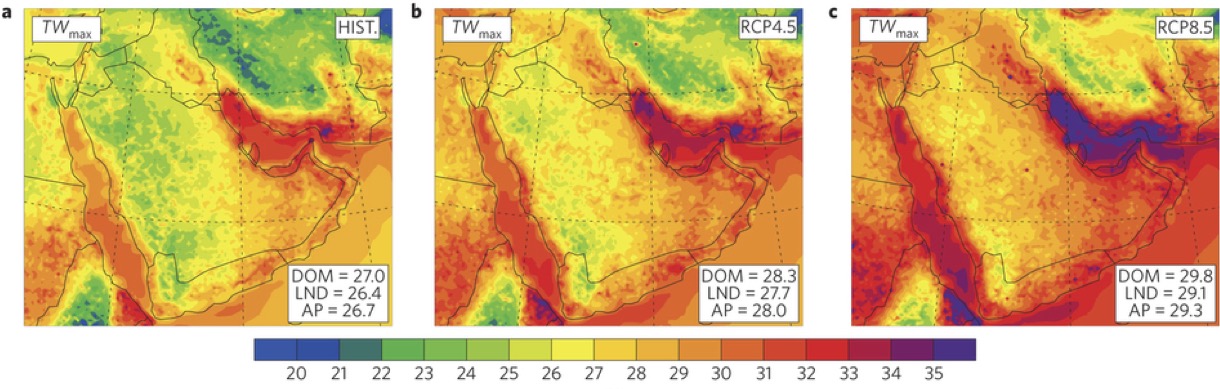
*Pal & Eltahir, Future temperature in southwest Asia projected to exceed threshold for human adaptability, Nature Climate Change, 2015, 6:197-200.
If all that sounds farfetched to you, consider that for the first time in recorded history this came very close to happening in 2015. On the 31st of July 2015 at Bandar Mahshahr Airport, Iran, the temperature was above 40C / 104F, the humidity was ~49% and the WBGT peaked at 34.6C / 94.3F. In terms of WBGT, this was the worst heat wave ever recorded.

*Map from… Christopher Schar, Climate Extremes: The worst heat waves yet to come, Nature Climate Change, 2016, 6:128-129.
There are many threats from climate change, but heat is probably the biggest threat that will impact people around the world. These effects will not be confined to the Middle East, many areas along the tropical belt and equator will also be affected. Not to mention that the health impacts will still be pretty bad in even the more temperate areas where people are not used to extreme heat.
So what happened during the French heat wave of 2006?
After the huge number of deaths following the 2003 heat wave in France, a national heat plan was created. The plan included finding out where all the vulnerable people were, real time surveillance of illness and death during heat waves, installing additional A/C equipment in hospitals and nursing homes, setting up an early warning system, and creating emergency plans to enact during heat waves.
Come mid-July of 2006 the temperature crept up to reach daytime highs of 35C / 95F. This was the second hottest heat wave in recent French history (2003 was the hottest).
The graph below tells another tale — a tale of adaptation.
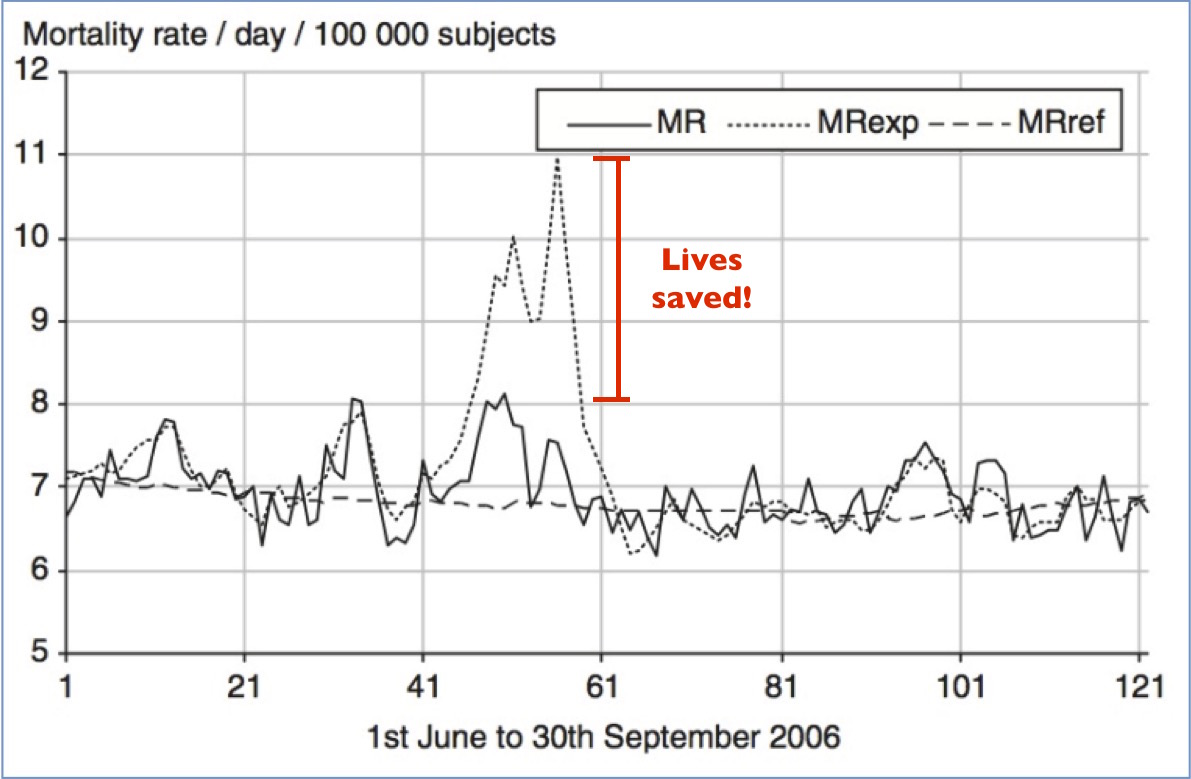
The expected number of deaths due to the heat wave should have been an additional 7,181, but only 2,087 additional deaths were seen. This represents 5,094 people that were saved by the public health measures put into effect by France’s national heat plan.
*Fouillet, et al. (2008), Has the impact of heat waves on mortality changed in France since the European heat wave of 2003? A study of the 2006 heat wave, Intl J Epi, 37:309-317.
Protecting Yourself from Extreme Heat
What France’s experience shows is that adaptive measure can work for large populations. Government action is important to protect society as a whole, and to protect those who are more vulnerable. But society’s preparedness also rests on you, the individual. There is plenty you can do to protect yourself and your family. Your behavior is the number one method for protecting yourself from extreme heat.
Protecting yourself from extreme heat starts with changing your behavior during heat waves, and may eventually involve moving to a cooler climate. The measures you take will differ depending on your personal risk factors and your available resources.
Some steps to take during a heat wave or even just hotter summer months…
- Stay hydrated by drinking plenty of water, even if you don’t feel thirsty.
- Seek air-conditioned spaces during the hottest parts of the day.
- Wear light, loose-fitting clothing and a wide-brimmed hat when outdoors.
- Avoid strenuous activity during peak heat hours.
- Check on vulnerable friends, family, and neighbors during heat waves.
- Learn the signs of heat illness and how to respond.
Some things you may do over the long term…
- install heavy curtains over windows that get a lot of sun. rejecting sun light and heat is super helpful to keep inside temps down.
- make sure your air conditioner is in good working order, whether a window unit or central air for your house
- make sure your refrigerator is in good condition. clean the coils, make sure air can circulate around it
- this is for cold drinks and ice! And to make sure your fridge doesn’t quit when you need it most.
- have backup power to run fans, window air-conditioners, or your whole house A/C, and your fridge
- make a “climate safe” room in your house. this is one room that is better insulated than other parts of your house or apartment
- make a personal “heat wave plan”. I just thought this up. If people can have a plan for disasters, why not for a heat wave?!
- list every step you might take, any resources to be gathered, people to check on, and so forth. Then practice it!
- have an emergency fund of money – get your finances in order. Haven’t talked about his in a long time, but it’s super important!
- start thinking about eventually moving North
- scout out places you’d like to go to, look at job advertisements in that area, look at housing/rental markets, etc.
- scout out places you’d like to go to, look at job advertisements in that area, look at housing/rental markets, etc.
On a broader scale, communities can implement heat action plans, like the one France developed after a deadly 2003 heat wave. These plans might include:
- Early warning systems
- Opening cooling centers
- Outreach to vulnerable populations
- Improving urban design to reduce heat islands
As our climate continues to warm, we must take heat waves seriously as a major health threat. By understanding the risks, taking personal precautions, and supporting community-wide adaptations, we can reduce the toll of extreme heat on our health and well-being.
Stay cool, stay safe, and remember: we’re all in this together as we face the challenges of a warming world.